
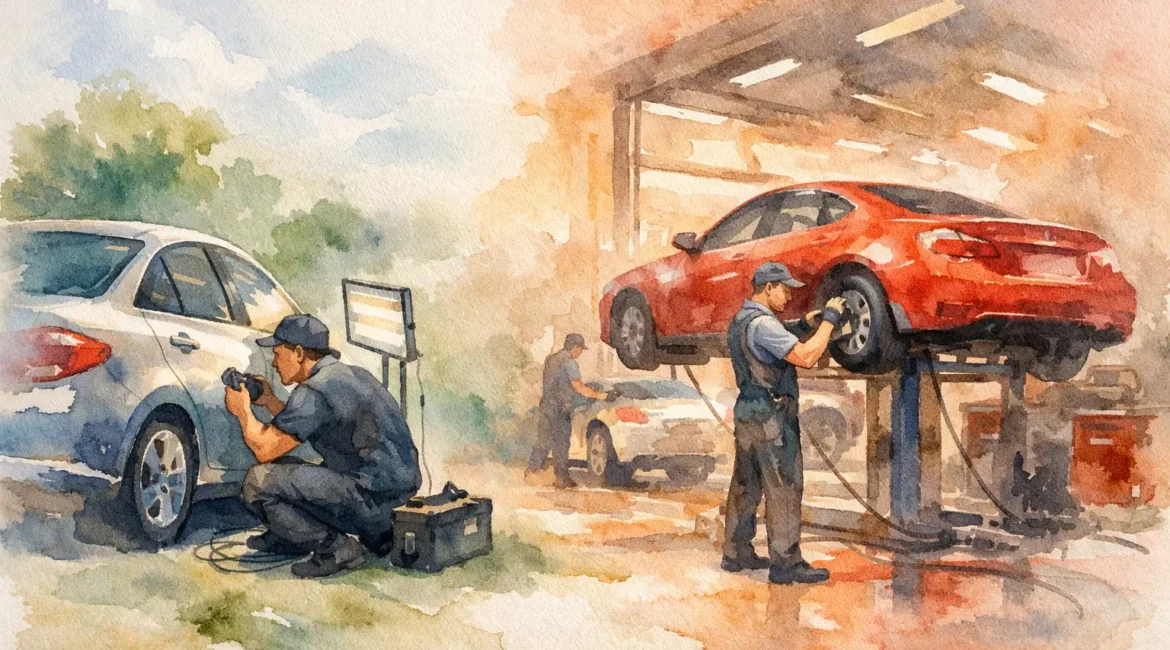
That small dent in the door always looks worse when the car is freshly washed. At that point, most drivers end up weighing up the same question: mobile dent repair vs bodyshop – which one actually makes sense for the damage, the budget and the finish you want? The honest answer is that both have their place. It depends on what has been damaged, how visible it is, and whether the job needs a quick cosmetic fix or a full repair to restore the panel properly.
Mobile dent repair vs bodyshop – the real difference
Mobile dent repair is built around convenience. A technician comes to your home or workplace and carries out minor cosmetic work on site, usually on small dents, scuffs or light panel damage. For busy drivers, that can be a real advantage. You avoid dropping the car off, arranging lifts and losing half a day.
A bodyshop is different. It is designed for repairs that need proper workshop conditions, specialist tools, paint matching equipment and controlled preparation. If the damage goes beyond a simple dent, a bodyshop gives you more options and usually a better standard of repair on anything complex, visible or structural.
This is where people sometimes get caught out. They assume a dent is just a dent. In reality, the method depends on the panel, the depth of the damage, whether the paint has been broken, and how close the dent is to an edge, crease or body line.
When mobile dent repair is the smart option
Mobile repair can be a very good choice when the damage is minor and localised. Think supermarket door dings, light parking dents, small scuffs on a bumper corner or shallow impressions where the paint surface is still largely intact. If the metal has not stretched badly and the area does not need a full strip, fill and repaint, mobile work can save both time and money.
For many everyday cars, this route is attractive because it deals with the issue quickly without turning a minor annoyance into a larger job. If you are returning a lease vehicle, tidying the car before sale or just want a noticeable blemish sorted fast, mobile repair often does exactly what you need.
It is also useful when convenience matters as much as the result. A lot of customers simply want the damage dealt with while they are at work or at home, without the disruption of being without the vehicle for days.
That said, mobile repair works best when expectations match the damage. It is ideal for improving a car significantly and, in the right hands, can produce an excellent finish. But it is not the answer to every dent.
When a bodyshop is the better choice
A bodyshop is usually the right route when the repair needs more than a quick cosmetic treatment. If the paint is cracked or flaking, if the dent sits across a sharp crease, if there is distortion around the edge of a panel, or if the bumper has split or moved out of line, workshop repair is often the safer choice.
The same applies if the damage affects multiple panels or follows an impact. Even what looks minor on the outside can hide broken clips, misalignment or deeper panel movement. A bodyshop can inspect the full area properly and repair it to a standard that lasts.
This matters most on newer cars, prestige vehicles and anything where appearance affects resale value. A poor repair is easy to spot in certain light. Mismatched paint, sanding marks, poor blending and uneven panel lines tend to show up over time, especially on metallic or pearlescent finishes. A proper bodyshop repair is about more than making the dent less obvious. It is about restoring the car so the damage is no longer the first thing you see.
Cost matters – but so does value
Most people first compare mobile dent repair vs bodyshop on price. Mobile repair is often cheaper upfront because the work is smaller in scope and overheads are lower. If the damage is genuinely minor, that can be excellent value.
But cheaper is not always better value in the long run. If the repair is at the limit of what mobile work can handle, you can end up paying for an improvement rather than a full correction. Then, if the result is not strong enough or the finish deteriorates, the job may still need to go into a bodyshop later.
A bodyshop repair can cost more because there is more involved – preparation, materials, painting, curing, blending and quality control. Yet for more serious or highly visible damage, that extra cost often buys a finish that looks right and lasts. For many customers, especially those planning to keep the car or protect its value, that is money better spent.
Finish quality – where expectations need to be honest
This is the point that matters most. If you are mainly concerned with convenience and decent cosmetic improvement, mobile repair can be a strong option. If you want the car restored as close as possible to pre-damage condition, a bodyshop usually gives you the best chance of achieving that.
Workshop conditions make a difference. Controlled preparation and paint application help produce a more consistent finish, especially on larger areas and more difficult colours. That is hard to replicate on a driveway in changing weather, with limited access and less room to manage dust, light and temperature.
For a small daily-driver dent, that may not matter much. For a crease on a front wing, damage near a wheel arch, or a mark running into adjacent panels, it matters a great deal. The more noticeable the area, the less you want to compromise.
Speed and convenience
Mobile repair wins on convenience when the job suits it. That is hard to argue with. If the technician can complete the repair outside your house or workplace in a short visit, that is a straightforward solution.
A bodyshop takes more planning, but it can still be convenient when the service is built around the customer. Collection and drop-off, clear booking times and realistic turnaround estimates all reduce the hassle. In practice, many drivers are happy to use a bodyshop if they know the repair will be done properly the first time.
Speed is also not always as simple as it sounds. A mobile repair might be quicker to arrange, but if the damage really needs workshop attention, using the wrong method first can slow everything down.
Insurance and accident damage change the picture
If the dent is part of a larger accident repair, the decision becomes easier. A bodyshop is typically the better option. Insurance work often involves more than visible panel damage. There may be alignment issues, broken fittings, hidden impact damage or several repair stages that need to be managed together.
This is where an experienced repairer adds real value. Instead of patching the obvious mark and sending the car back out, they assess the whole job, handle the repair process properly and, where relevant, help with claim-related support. For drivers around Glasgow dealing with non-fault accident damage, that kind of support can save time and stress.
How to decide what your car needs
The simplest way to choose is to look at three things: the type of damage, how important the finish is to you, and whether you want a cosmetic improvement or a full restoration.
If it is a small dent with no major paint damage, mobile repair may be all you need. If the panel is creased, the paint is broken, the bumper is split, or the area is highly visible, a bodyshop is usually the better call. The same goes for anything affecting panel shape, alignment or resale value.
A good repairer will tell you honestly which route fits the job instead of trying to force every repair into one service model. That matters. The best outcome comes from matching the method to the damage, not from choosing the cheapest or quickest option by default.
For customers who want the reassurance of experienced workmanship, proper inspection and a finish that stands up over time, a specialist bodyshop such as Unique Bodywork is often the safer bet on anything beyond the most minor cosmetic damage.
The right repair is the one that leaves you confident every time you walk back to the car, rather than wondering if you should have had it done properly in the first place.